
When sourcing skateboards from China, one of the first decisions buyers face is whether to work directly with a skateboard factory or through a trading company.
At first glance, the difference may seem simple. A factory manufactures products, while a trading company sources products from factories and sells them to overseas customers. In reality, the supply chain can be more complicated. Some companies combine manufacturing and trading activities, while some trading companies have long-term relationships with several specialized factories.
For skateboard brands, sporting-goods retailers, distributors, importers and toy companies, the more important question is not simply:
“Is this company a factory or a trading company?”
The better question is:
“Which sourcing model gives my project the right combination of product quality, customization, communication, cost, production control and long-term supply?”
Understanding the difference can help buyers reduce sourcing risks and choose a supplier that matches their project.
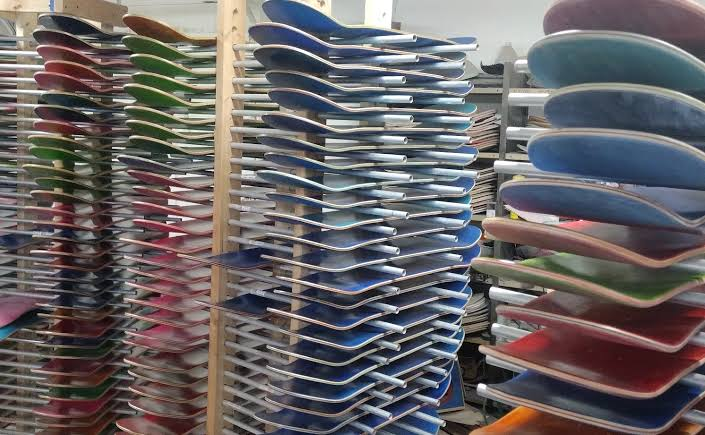
Factory vs Trading Company: What Is the Difference?
A skateboard factory normally has direct involvement in manufacturing activities. Depending on its capabilities, this may include deck pressing, shaping, printing, component assembly, quality control, packaging and other production processes.
A factory-based supplier can usually provide more direct information about manufacturing specifications, production capacity and quality-control procedures.
For example, a buyer developing a custom skateboard may need to discuss:
- Deck material and construction
- Deck size, shape and concave
- Graphics and printing
- Trucks and wheel specifications
- Bearings and grip tape
- Packaging
- Product testing and compliance
- Production quantity
- Quality-control requirements
Direct communication with the manufacturing team can be particularly valuable when the project involves significant customization.
You can learn more about what to look for in a manufacturing partner on our Skateboard Manufacturer page.
A trading company, on the other hand, may not manufacture the skateboard itself. Instead, it may source products from one or more factories and manage communication, purchasing, quality control, packaging or export logistics for the customer.
This model can also be useful.
For example, a buyer may want to source several unrelated sporting-goods products from China. A trading company may be able to coordinate multiple factories and consolidate the order, reducing the amount of supplier management required by the buyer.
The important point is that “factory” does not automatically mean better, and “trading company” does not automatically mean worse.
The right choice depends on the project.
When Should You Work Directly With a Skateboard Factory?
For many skateboard brands and B2B buyers, working directly with a manufacturer makes sense when the project requires product customization and long-term production.
1. You Need a Custom Skateboard
If you only need standard skateboards from an existing catalog, several sourcing models may work.
However, if you want to develop your own product specifications, direct factory communication can become much more important.
A custom project may involve deck construction, concave, dimensions, graphics, component combinations and packaging.
The more variables your project contains, the more important it becomes to understand who is actually responsible for manufacturing.
For example, if you are launching a private-label skateboard line, you may need the same specifications to be reproduced across multiple production runs.
You can learn more about the manufacturing process on our Skateboard Manufacturing Process page.
2. You Plan to Place Repeat Orders
A one-time purchase and a long-term product program are very different.
If you expect to reorder the same skateboard every few months, you need consistent specifications and production standards.
Direct communication with a manufacturer can make it easier to establish:
- Approved samples
- Production specifications
- Artwork standards
- Component specifications
- Packaging requirements
- Quality-control checkpoints
- Repeat-order procedures
This becomes particularly important for established skateboard brands and retail programs.
3. You Need Factory-Level Customization
Some buyers want to customize only the graphic design.
Others want to customize the entire product.
For example:
Deck → Shape → Concave → Graphics → Trucks → Wheels → Bearings → Grip Tape → Packaging
When customization extends across several parts of the product, buyers should understand whether the supplier has direct control over these manufacturing processes or is coordinating them through third parties.
4. You Want to Build a Long-Term Manufacturing Relationship
A factory relationship can become more valuable as your business grows.
Your first order may be relatively simple. Later, you may need new deck shapes, additional SKUs, updated packaging, different components or new market requirements.
Having a manufacturing partner that understands your product history can make future development more efficient.
When Can a Trading Company Be the Better Choice?
There are also situations where working with a trading company or sourcing company can be practical.
1. You Need Multiple Product Categories
Suppose a buyer wants skateboards, helmets, protective equipment, sports bags and other sporting goods in one purchasing program.
Finding and managing a specialized factory for every product category can take significant time.
A trading company may simplify this process by coordinating multiple suppliers.
2. You Have Limited China Sourcing Experience
New importers may not know how to evaluate factories, compare quotations, check samples or manage production inspections.
An experienced sourcing company can potentially help with supplier identification, communication, inspection and logistics.
The value comes from the sourcing and management service rather than simply adding another company between the buyer and manufacturer.
3. Your Project Requires Several Suppliers
Some product programs naturally involve multiple manufacturing sources.
For example, one supplier may specialize in a particular product while another handles packaging or accessories.
In these situations, a capable sourcing partner may help coordinate the supply chain.
However, buyers should still ask for transparency.
You should know:
- Who manufactures the product?
- Where is production located?
- Who performs quality control?
- Who owns the tooling and artwork?
- Who is responsible if specifications are not met?
- What happens if the factory changes?
A good sourcing relationship should make these responsibilities clear.
How Can Buyers Tell Whether a Skateboard Supplier Is Really a Factory?
This is one of the most important questions for overseas buyers.
A company website alone is not always enough to determine how a supply chain is structured. Buyers should verify the manufacturing relationship before placing a significant order.
Here are several practical checks.
Check 1: Ask About the Factory
Ask for the factory location, production area and manufacturing capabilities.
A legitimate manufacturer should be able to explain what it actually produces and which processes are performed in-house.
If the answer is vague, ask more specific questions.
Check 2: Request Factory Photos or a Factory Tour
Production-line photographs can provide useful evidence.
For larger projects, a video factory tour or third-party inspection can provide additional confidence.
Look for evidence of actual manufacturing activities rather than only product showroom photographs.
Check 3: Ask Detailed Technical Questions
A genuine manufacturer should be comfortable discussing technical specifications.
For skateboards, this can include deck construction, pressing, CNC shaping, printing, component specifications, assembly and packaging.
A supplier that cannot answer basic manufacturing questions may be relying heavily on an external factory.
Check 4: Understand the Quotation
Do not compare suppliers only by the final unit price.
Ask what is included:
- Product specifications
- Packaging
- Printing
- Tooling
- Sample development
- Quality inspection
- Export packaging
- Shipping terms
A lower initial quotation may not represent a lower total sourcing cost.
Check 5: Verify the Production Process
A professional supplier should be able to explain the basic path from specification to finished product:
Specification → Sample → Approval → Production → QC → Packaging → Shipment
This process is particularly important for OEM and private-label projects.
If you are specifically looking for a China-based manufacturing partner, visit our Skateboard Manufacturer in China page to learn more about factory-based sourcing.
What Should Skateboard Buyers Consider Before Choosing a Supplier?
The factory-versus-trading-company question should ultimately be part of a larger supplier evaluation.
Consider these seven factors:
Product Capability
Can the supplier manufacture the product you actually need?
Customization
Can they handle your deck specifications, graphics, components and packaging?
Quality Control
Who checks the product, and at what stages?
MOQ
Does the minimum order quantity fit your business model?
Lead Time
Can the supplier provide a realistic production schedule?
Communication
Can the team clearly understand specifications and resolve production issues?
Long-Term Supply
Can the supplier support repeat orders and future product development?
A supplier that performs well across these areas may be more valuable than a supplier that simply offers the lowest price.
For buyers developing a new skateboard line, it is usually better to compare suppliers using the total sourcing value rather than unit price alone.
FAQ
Is it cheaper to buy directly from a skateboard factory?
Not necessarily. Direct factory sourcing can reduce an additional trading margin in some situations, but total cost depends on product specifications, order quantity, customization, packaging, logistics and payment terms.
Are all skateboard trading companies middlemen?
No. Some trading companies provide genuine sourcing, quality-control and supply-chain management services. The key is understanding what value they provide and whether the underlying factory is transparent.
How can I verify a China skateboard factory?
Ask for the factory address, production capabilities, factory photographs, certifications, samples and manufacturing process. For larger orders, buyers can also consider an independent factory audit or inspection.
Should a new skateboard brand work directly with a factory?
If the brand is developing custom products and expects repeat orders, direct communication with a capable factory can be advantageous. However, a sourcing company can also be useful for buyers who need help managing multiple suppliers or product categories.
What information should I send a skateboard manufacturer for a quotation?
Provide your product type, target quantity, deck size and construction, graphics, components, packaging requirements, destination market and target delivery date. The more specific your requirements are, the more useful the quotation will be.
Conclusion
Choosing between a skateboard factory and a trading company is not simply a question of choosing the cheapest supplier.
For custom skateboard brands, private-label programs and long-term product development, direct access to manufacturing capabilities can provide important advantages in communication, customization and production control.
For buyers managing multiple product categories or suppliers, a capable trading or sourcing company can provide valuable coordination and procurement support.
The best approach is to evaluate the actual supply chain behind the quotation.
Ask who manufactures the product, who controls quality, who owns the specifications, how customization is handled and whether the supplier can support your business as it grows.
At Yobang Sports, we focus on skateboard manufacturing for brands, distributors, sporting-goods buyers and toy companies. Our capabilities include custom skateboard decks, complete skateboards and kids’ skateboards for OEM and private-label projects.
If you already have a skateboard specification, artwork or product idea, send us your requirements and let us evaluate the project.
REQUEST A QUOTE
Request a Skateboard Manufacturing Quote
Tell us your product requirements, estimated quantity, target market and customization needs. Our team can review your project and provide a manufacturing quotation based on your specifications.