
Bearings are small components, but they are an important part of every complete skateboard.
For skateboard brands and B2B buyers, bearing specifications can be confusing because products are often marketed using terms such as ABEC 5, ABEC 7 and ABEC 9.
A common assumption is simple:
Higher ABEC = faster skateboard.
That is not necessarily true.
ABEC is a system related to bearing manufacturing tolerances. It does not measure every factor that determines how a skateboard bearing performs in a real-world skateboard setup. Recent bearing guides also emphasize that ABEC should not be treated as a direct speed rating.
For buyers developing OEM or private-label skateboards, the better approach is to evaluate the entire bearing specification, including materials, construction, lubrication, shields and quality control.
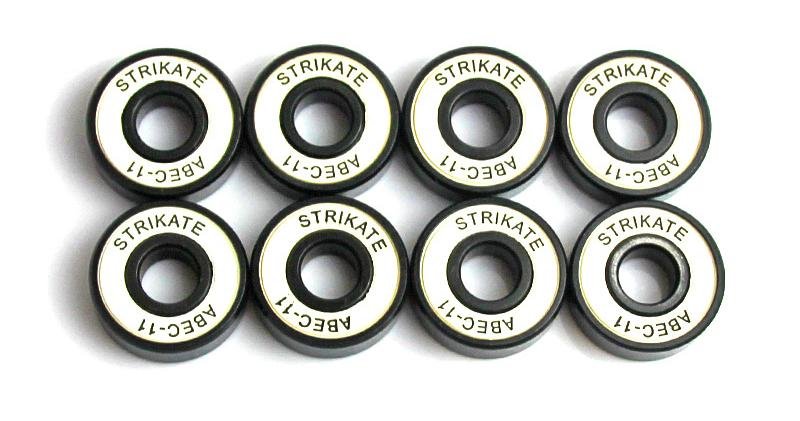
1. What Does ABEC Mean?
ABEC stands for Annular Bearing Engineers’ Committee.
The rating system is used to classify certain dimensional and manufacturing tolerances of bearings.
The commonly encountered ratings are:
- ABEC 1
- ABEC 3
- ABEC 5
- ABEC 7
- ABEC 9
Higher ABEC numbers indicate tighter manufacturing tolerances within the areas measured by the standard.
However, ABEC does not directly tell a skateboard buyer:
- How fast the bearing will roll
- How durable it will be
- What steel is used
- What lubricant is used
- How effective the seals are
- How the bearing handles skating loads
- How long the bearing will last
This distinction is extremely important.
A bearing with a higher ABEC number is not automatically a better skateboard bearing.
For B2B buyers, ABEC should therefore be treated as one specification among several, not the complete definition of bearing quality.
2. ABEC 5 vs ABEC 7 vs ABEC 9
So how should buyers compare ABEC ratings?
ABEC 5
ABEC 5 is commonly used as a practical specification for many general-purpose products.
For an entry-level or mid-range complete skateboard, ABEC 5 can be a reasonable specification depending on the overall product positioning.
The key is to evaluate the actual bearing quality rather than selecting it simply because of the number.
ABEC 7
ABEC 7 represents tighter tolerances than ABEC 5 within the ABEC system.
For a premium product line, some brands may choose ABEC 7 as part of their bearing specification.
However, moving from ABEC 5 to ABEC 7 does not automatically mean the skateboard will feel dramatically faster.
The rest of the bearing construction still matters.
ABEC 9
ABEC 9 has even tighter specified tolerances.
It may be appropriate for certain premium product positioning, but buyers should not assume that ABEC 9 automatically produces a faster or longer-lasting skateboard.
If a manufacturer quotes a large price difference between ABEC 5 and ABEC 9, ask what additional product value the higher specification provides.
This is especially important when developing products for price-sensitive retail markets.
3. What Matters Besides ABEC?
A complete bearing specification should go beyond the ABEC number.
Bearing Material
Material quality can affect durability and performance.
Chrome steel is a common bearing material for skateboard applications, while ceramic or hybrid constructions may be offered for specialized or premium products.
Lubrication
Lubrication influences the bearing’s operating characteristics.
The lubricant needs to be appropriate for the intended application and production specification.
Shields and Seals
Bearings may use different shield or seal configurations.
These components help protect the internal bearing elements from contamination.
For skateboarding, where bearings may encounter dust, dirt, moisture and debris, protection from contamination is important.
Manufacturing Quality
Consistent manufacturing is critical.
A bearing should be produced to the specified dimensions and quality standards.
For an OEM buyer, this means the approved bearing specification should remain consistent between production batches.
Internal Construction
Bearing geometry, ball quality, raceway design and internal clearances can all influence actual performance.
This is one reason ABEC should not be treated as a complete performance rating.
Industry explanations consistently note that ABEC measures specific tolerances but does not cover all factors relevant to skateboard performance.
4. How Should Brands Choose Bearings for a Product Line?
The correct bearing specification depends on product positioning.
Entry-Level Skateboard
An entry-level skateboard may prioritize:
- Competitive cost
- Reliable basic performance
- Consistent production
- Suitable durability
An ABEC 5 bearing can be considered as one possible specification.
Mid-Range Product
A mid-range skateboard may require a stronger balance between cost, performance and product presentation.
The brand could consider a higher bearing specification depending on its target market and retail positioning.
Premium Product
A premium skateboard may use higher-grade materials or specialized bearing constructions.
However, premium positioning should be supported by actual product improvements rather than simply printing “ABEC 9” on the packaging.
The product should be evaluated as a whole.
Kids’ Skateboards
For kids’ products, the manufacturer should focus on the complete product specification, safety requirements, appropriate components and reliable assembly.
The highest ABEC rating should not automatically be the objective.
The bearing should be appropriate for the intended product and target market.
You can learn more about component selection on our Skateboard Components page.
How Many Bearings Does a Complete Skateboard Need?
A standard skateboard uses four wheels.
Each wheel normally requires two bearings.
Therefore:
4 wheels × 2 bearings = 8 bearings
A complete skateboard commonly also uses bearing spacers and speed rings depending on the configuration.
For an OEM project, these small components should be included in the complete product specification.
If you are developing a fully assembled product, our Complete Skateboard Manufacturer page provides more information about complete-board production.
What Should Buyers Ask a Bearing Supplier?
When comparing bearing quotations, do not ask only:
“Is it ABEC 7?”
Instead, request a complete specification.
Ask about:
- ABEC rating
- Bearing size
- Material
- Ball material
- Shield/seal type
- Lubricant
- Bearing construction
- Packaging
- Quality-control process
- Sample availability
- MOQ
- Production consistency
The standard skateboard bearing size is commonly based around the 608 bearing format, but buyers should still confirm the exact specification required for their product.
For private-label products, packaging and labeling can also be customized.
If your goal is to develop a branded complete skateboard, an experienced OEM Skateboard Manufacturer can coordinate the bearing specification with the deck, trucks and wheels.
FAQ
Does a higher ABEC rating mean a faster skateboard?
No. ABEC measures specific manufacturing tolerances. It does not directly measure skateboard speed or overall bearing performance.
Is ABEC 9 better than ABEC 5?
ABEC 9 has tighter tolerances in the areas measured by the ABEC system, but that does not automatically mean it will perform better in every skateboard application.
What is the most important factor when choosing skateboard bearings?
There is no single factor. Buyers should consider material quality, manufacturing consistency, seals or shields, lubrication, internal construction, product positioning and cost.
How many bearings does a skateboard need?
A standard four-wheel skateboard normally uses eight bearings, with two bearings per wheel.
Can I customize skateboard bearings for my brand?
Depending on the supplier and order quantity, brands may be able to customize bearing specifications, packaging, colors or branding. The exact options should be confirmed during the OEM development process.
Conclusion
ABEC ratings are useful technical information, but they should not be treated as a simple ranking from “slow” to “fast.”
ABEC describes specific bearing manufacturing tolerances. It does not measure every factor that determines how a bearing performs inside a skateboard.
For B2B buyers, a better approach is to evaluate the complete bearing specification, including material, internal construction, lubrication, shields, quality control and consistency.
The correct bearing for an entry-level skateboard may be very different from the bearing specification used for a premium product.
Ultimately, the bearing should support the overall product positioning rather than simply provide the highest possible ABEC number.
Yobang Sports can coordinate skateboard components as part of complete skateboard OEM and private-label manufacturing programs.
REQUEST A QUOTE
Request a Skateboard Manufacturing Quote
Send us your target skateboard product, estimated quantity, market and preferred bearing specification. If you are unsure whether ABEC 5, ABEC 7 or another configuration is appropriate, tell us your target price and product positioning and our team can help evaluate the options.