
For toy companies, developing a custom kids skateboard can be an attractive way to expand an outdoor toy portfolio.
But creating a successful children’s skateboard is different from simply putting a logo on an existing skateboard.
A real custom skateboard project can involve:
- Deck material
- Deck dimensions
- Shape
- Colors
- Graphics
- Wheels
- Trucks
- Bearings
- Grip tape
- Packaging
- Safety requirements
- Testing
- Product labeling
- Carton specifications
For a toy company, the challenge is to balance design, safety, cost, production quantity and retail positioning.
The best approach is to treat the skateboard as a complete consumer product from the beginning.
This guide explains how toy companies can work with an OEM skateboard manufacturer to develop a custom kids skateboard.
Start With the Target Customer
Before contacting a manufacturer, define who the product is for.
A skateboard for a 3–5-year-old child is not the same product as a skateboard for an 8–12-year-old.
Define:
- Target age
- Target rider weight
- Intended use
- Skill level
- Target market
- Retail channel
- Target retail price
This information gives the manufacturer a starting point for product development.
For example, a toy company selling through mass-market retailers may prioritize:
- Competitive cost
- Bright colors
- Character graphics
- Simple packaging
- Easy SKU management
A toy company selling through premium specialty retailers may prioritize:
- Maple deck construction
- Higher-quality components
- Premium printing
- More sophisticated packaging
- Stronger skateboard branding
The product strategy should come before the factory quotation.
Choose PP or Maple
One of the first technical decisions is deck material.
PP and maple offer different product-development possibilities.
PP Decks
PP can be suitable for:
- Entry-level products
- Colorful children’s products
- Molded shapes
- Toy-oriented product lines
- High-volume programs
The manufacturer can evaluate molded shapes, surface treatment and color requirements based on the product concept.
Maple Decks
Maple is often considered when a toy company wants:
- Traditional skateboard construction
- Premium positioning
- A sporting-goods appearance
- Stronger connection with skateboard culture
- A product that resembles an adult skateboard
For a detailed comparison, buyers can also read our guide on PP vs Maple Kids Skateboards.
The decision should not be based on price alone.
It should reflect the entire product strategy.
Develop the Product Specification
Once the material direction is selected, create a product specification.
Deck
Specify:
- Length
- Width
- Thickness
- Shape
- Concave
- Wheelbase
- Material
- Color
- Graphic
- Logo position
Trucks
Specify:
- Truck width
- Material
- Finish
- Color
- Baseplate requirements
- Bushing specification
Wheels
Specify:
- Diameter
- Hardness
- Color
- Shape
- Core
- Graphic
Bearings
Specify:
- Bearing type
- ABEC requirement if applicable
- Shield/seal configuration
- Lubrication
- Branding
Grip Tape
Specify:
- Color
- Grit
- Logo
- Die-cut shape
- Printing requirements
Packaging
Specify:
- Individual box
- Polybag
- Hangtag
- Instruction sheet
- Barcode
- Warning labels
- Carton marks
This level of detail gives the factory enough information to quote accurately.
Create the Product Around the Brand
Toy companies often have an advantage: they understand characters and visual storytelling.
Use that advantage.
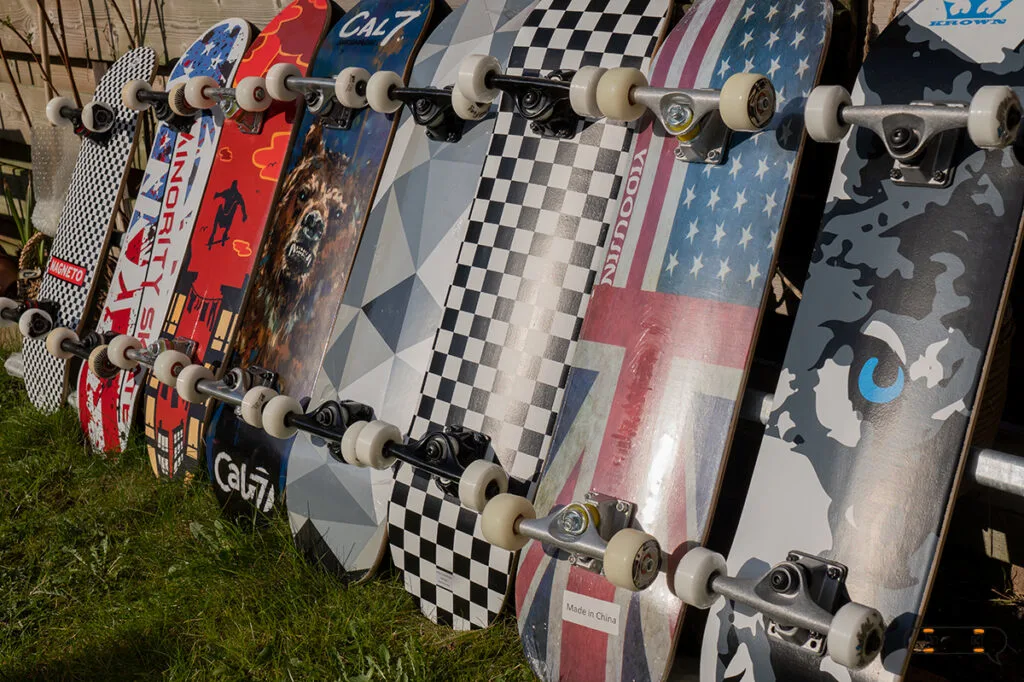
Instead of simply printing a logo on a generic skateboard, consider developing a complete visual system.
For example:
Product Line A
- Pink deck
- Unicorn graphics
- Matching wheels
- Character packaging
Product Line B
- Blue deck
- Dinosaur graphics
- Green wheels
- Character packaging
Product Line C
- Purple deck
- Space graphics
- Custom packaging
The basic manufacturing platform can remain similar while the visual identity changes.
This can make SKU development more efficient.
However, buyers should discuss minimum quantities for different colors and graphics before finalizing the collection.
Decide Whether You Need a New Mold
Not every custom skateboard requires completely new tooling.
This is an important cost consideration.
There are several levels of customization.
Level 1: Graphic Customization
The factory already has a suitable deck.
You customize:
- Graphic
- Logo
- Colors
- Packaging
This is usually the simplest approach.
Level 2: Specification Customization
You change:
- Deck dimensions
- Wheel size
- Truck specification
- Component colors
- Grip tape
This requires more product development.
Level 3: Structural Customization
You create:
- New deck shape
- New mold
- Special concave
- Special wheel configuration
- Custom molded PP structure
This is a deeper OEM project.
Tooling and sample development should be discussed before production.
For companies developing multiple products, it may be worth creating a platform that can support several SKUs.
Work With a Kids Skateboard Manufacturer
A toy company should ideally work with a factory that understands both skateboard manufacturing and children’s products.
Our Kids Skateboard Manufacturer service is designed for toy companies and brands developing children’s skateboards.
For private-label projects, our Private Label Skateboards service can support branding, graphics and packaging requirements.
For broader OEM projects, see our OEM Skateboard Manufacturer page.
If you need a complete skateboard rather than a deck-only project, our Complete Skateboard Manufacturer service covers the full board configuration.
Consider Compliance Before Artwork
Toy companies sometimes finalize artwork before discussing compliance.
That can create unnecessary problems.
Before printing packaging, determine:
- Target market
- Target age
- Applicable safety requirements
- Warning labels
- Product information
- Testing requirements
- Certification documents
For U.S. children’s toys, ASTM F963 is part of the mandatory federal toy safety framework, and CPSC states that applicable children’s products require third-party testing and certification.
Therefore, packaging and product design should be developed with compliance in mind.
Do not wait until the product is already in mass production.
Build a Prototype
A prototype allows the toy company to evaluate:
- Appearance
- Size
- Weight
- Graphics
- Component matching
- Packaging
- Assembly
- Product feel
For a children’s product, it also provides an opportunity to identify design issues before mass production.
A good sample process should include:
- Initial specification
- Factory quotation
- Prototype
- Sample review
- Modification
- Final sample approval
- Testing
- Mass production
Do not rush directly from artwork to mass production.
How Toy Companies Should Control Cost
The best way to control cost is not always to choose the cheapest material.
Instead, control the number of variables.
For example:
Use the same:
- Deck platform
- Truck
- Bearing
- Wheel
- Grip tape
across several SKUs.
Then change:
- Deck color
- Graphic
- Packaging
- Character artwork
This can simplify purchasing and production.
It may also make quality control easier.
Another important factor is packaging.
A custom retail box can add significant cost compared with simpler packaging.
If your product is intended for mass retail, discuss packaging requirements with the factory early.
Develop Packaging for Retail
Packaging is particularly important for toy companies.
The package may need to communicate:
- Age range
- Product benefits
- Brand
- Character
- Safety information
- Barcode
- Country of origin
- Instructions
- Warnings
It also needs to protect the skateboard during international transportation.
A beautiful retail box is not useful if the skateboard arrives damaged.
Therefore, packaging should be evaluated through both marketing and logistics.
Plan Your SKU Strategy
Before ordering, create a simple SKU matrix.
| SKU | Deck | Graphic | Wheel | Packaging | Target Market |
|---|---|---|---|---|---|
| 001 | PP | Unicorn | Pink | Custom Box | USA |
| 002 | PP | Dinosaur | Green | Custom Box | USA |
| 003 | Maple | Space | Blue | Custom Box | Europe |
| 004 | Maple | Street | Black | Custom Box | Europe |
Then discuss:
- MOQ per SKU
- Total order quantity
- Mixed-SKU production
- Packaging MOQ
- Color MOQ
- Artwork setup
- Tooling
- Sample quantity
This makes the project much easier for both the buyer and factory.
What Information Should You Send to the Factory?
A toy company should ideally send:
- Company name
- Target market
- Target age
- Product concept
- Reference photos
- Deck material preference
- Dimensions
- Graphics
- Estimated quantity
- Packaging requirements
- Target retail price
- Required certifications/testing
If you don’t know all the technical specifications yet, that’s fine.
A good manufacturer can help turn the product concept into a technical specification.
FAQ
Can toy companies customize the entire skateboard?
Yes.
Depending on the project, customization can include deck shape, material, graphics, wheels, trucks, bearings, grip tape and packaging.
Do toy companies need to create their own skateboard design?
Not necessarily.
A manufacturer can provide standard product platforms that can then be customized.
Is PP or maple better for toy companies?
It depends on the product positioning.
PP can work well for colorful and entry-level products, while maple can support a more traditional or premium skateboard position.
Can one skateboard design have multiple graphics?
Yes.
Many product lines use the same basic manufacturing platform with different graphics and packaging.
How early should testing be considered?
Testing should be considered during product development, not after mass production.
Can toy companies order private-label skateboards?
Yes.
Private-label production can include branding, graphics, packaging and other product specifications.
Conclusion
Developing a custom kids skateboard is a product-development project, not simply a printing project.
Toy companies should begin with:
- Target age
- Target market
- Product positioning
- Deck material
- Complete-board specification
- Graphics
- Packaging
- Testing
- Quantity
- Retail strategy
The earlier these decisions are made, the easier it is to control cost and production risk.
If your company is developing a new children’s skateboard collection, work with a manufacturer that can support the project from prototype through mass production.
REQUEST A QUOTE
Send Yobang Sports your product concept, target market, quantity and artwork.