
When developing a skateboard product line, wheel selection is often treated as a simple component decision. In reality, wheels can significantly influence the feel, appearance and positioning of the finished skateboard.
For skateboard brands, distributors, sporting-goods buyers and toy companies, choosing the right wheels means considering more than color and price. Diameter, durometer, shape, contact patch and core construction can all affect how the complete skateboard performs.
The right wheel for a technical street skateboard may not be the right wheel for a cruiser, beginner product or kids’ skateboard.
This is why wheel selection should start with the product line rather than with an individual wheel specification.
A professional skateboard components supplier or manufacturer should be able to help buyers match wheel specifications with the deck, trucks and intended application.
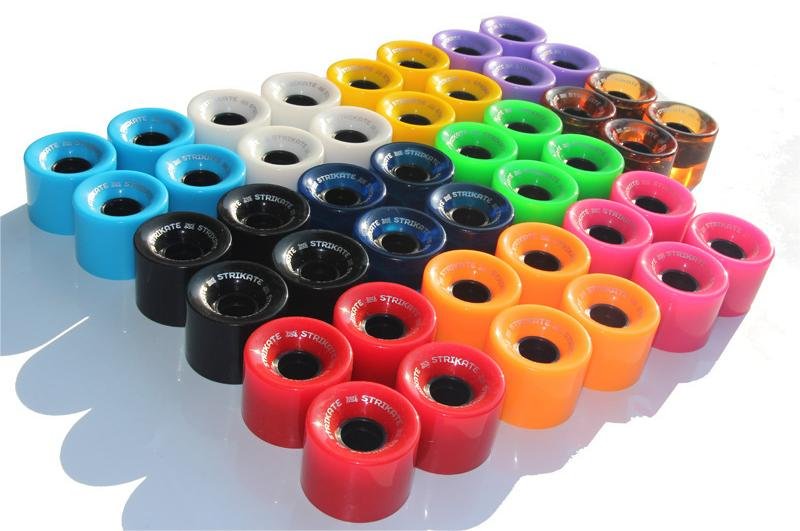
1. Understand the Main Skateboard Wheel Specifications
Before choosing wheels for a product line, buyers should understand the specifications that appear on a wheel quotation or product sheet.
Diameter
Wheel diameter is measured in millimeters.
Smaller wheels generally reduce weight and can make a setup feel more responsive, while larger wheels can provide more speed and roll more easily over rough surfaces.
For standard street and park skateboards, wheels are commonly found in approximately the 50–60 mm range. Wheels above this range are more frequently associated with cruisers and longboards.
However, diameter should always be considered together with the complete skateboard configuration.
Durometer
Durometer describes wheel hardness.
Many skateboard wheels use the A scale, with higher numbers indicating harder wheels. Softer wheels generally provide more grip and absorb more vibration, while harder wheels are commonly preferred for smooth surfaces, technical skating and slides.
Typical product specifications may include values such as:
- 78A
- 80A
- 83A
- 85A
- 90A
- 95A
- 99A
- 101A
These numbers should be treated as part of the product specification rather than as a universal ranking system.
Shape and Contact Patch
Wheel shape determines how much polyurethane contacts the riding surface.
A wider contact patch can provide more grip, while a narrower profile may feel more responsive for certain applications.
Wheel edges can also be rounded or more squared depending on the intended product.
Core Construction
The wheel core supports the bearing and influences the structural characteristics of the wheel.
For an OEM project, buyers may also specify core color, material and design.
2. How to Choose Wheels for Different Skateboard Product Lines
Different product lines require different wheel configurations.
Technical Street Skateboards
For a street-oriented product, brands often prioritize lighter wheels, responsive handling and compatibility with technical skating.
A common starting point is a smaller diameter with a harder durometer.
For example, 52–54 mm and approximately 99A–101A can be considered as a starting specification for a traditional street-oriented product, although the final choice should depend on the complete setup and target rider.
Smaller, harder wheels are widely associated with street and technical skating because they can reduce weight and provide a responsive feel on smooth surfaces.
Park and General Skateboards
A general-purpose product line may benefit from a more versatile wheel specification.
A mid-range diameter such as 54–58 mm can provide a balance between maneuverability and rolling performance.
Hardness can also be positioned around the mid-to-high range depending on the intended riding surface.
For brands developing a mainstream skateboard, the goal should be versatility rather than selecting an extreme specification.
Cruiser Skateboards
Cruiser products generally have different requirements.
A cruiser may need to roll comfortably over sidewalks, pavement and less-than-perfect surfaces.
Larger and softer wheels can provide more grip and vibration absorption than small hard street wheels.
For example, a product may use wheels around 55 mm or larger with a softer durometer, depending on the deck, truck height and target application.
The exact specification should be tested as a complete setup because larger wheels can also create wheel-bite considerations.
Kids’ Skateboards
Kids’ skateboards require additional attention to the target age, rider size and product category.
The goal is not simply to install the smallest available wheel.
The complete product should be evaluated for:
- Deck dimensions
- Truck size
- Wheel diameter
- Wheel hardness
- Product weight
- Stability
- Packaging
- Applicable safety requirements
For toy and sporting-goods companies developing children’s products, wheel specifications should be established together with the overall product design.
You can also review our Complete Skateboard Manufacturer page if you are developing a fully assembled product.
3. Match Wheels With the Deck and Trucks
Wheel selection should never be made independently.
The basic relationship is:
Deck → Trucks → Wheels → Bearings → Complete Setup
For example, a large wheel installed on a low truck can increase the risk of wheel bite.
Similarly, a wheel that is too narrow or too wide for the intended setup can change the handling characteristics.
Brands should therefore provide the manufacturer with the complete product specification.
Important information includes:
- Deck width
- Truck width
- Truck height
- Wheel diameter
- Wheel width
- Durometer
- Wheel shape
- Bearing specification
- Riser pad requirements
If you are developing a new product, an experienced OEM skateboard manufacturer can help evaluate these specifications as a complete system.
This is particularly useful when the buyer does not yet have a finalized wheel specification.
4. How Should Brands Develop Wheel Specifications for a Product Line?
A good product line should have a clear reason for every wheel configuration.
For example:
Street Model
52–54 mm / hard durometer / technical focus
All-Around Model
54–58 mm / medium-to-hard durometer / versatile use
Cruiser Model
55–65+ mm / softer durometer / comfort and rough-surface use
These are not universal rules. They are starting points for product development.
The actual specifications should be confirmed through sampling and testing.
Brands should also consider commercial factors.
If you create five nearly identical wheel configurations, you may create unnecessary SKUs.
Instead, a more focused product line may be easier to manufacture, stock and explain to distributors.
Wheel appearance also matters.
Brands can customize:
- Wheel color
- Core color
- Logo
- Graphic printing
- Packaging
- Durometer
- Diameter
- Shape
This allows wheels to become part of the visual identity of the skateboard rather than simply a functional component.
For buyers developing a complete skateboard program, our Skateboard Components page can be used as a reference when planning component specifications.
FAQ
What skateboard wheel size is best for a product line?
There is no single best size. Smaller wheels are commonly used for technical street products, while larger wheels can be more suitable for cruising and rough surfaces. The correct size depends on the product category and complete setup.
What skateboard wheel hardness should I choose?
Hard wheels are commonly used for smooth surfaces and technical skating, while softer wheels provide more grip and vibration absorption. The appropriate durometer depends on the intended application.
Are bigger skateboard wheels faster?
Larger wheels can maintain speed and roll over rough surfaces more easily, but they also add weight and can change handling. Wheel diameter should be evaluated together with truck height and deck design.
Can I customize skateboard wheel colors?
Yes. Depending on the manufacturer’s capabilities and order quantity, brands can often customize wheel color, core color, graphics and other specifications.
Should skateboard wheels and trucks be selected together?
Yes. Truck height and width affect wheel compatibility and the overall setup. Wheel diameter should therefore be finalized together with the deck and truck specifications.
Conclusion
Choosing skateboard wheels for a product line is not simply a matter of selecting the cheapest wheel or the highest hardness rating.
Brands should consider diameter, durometer, shape, contact patch and core construction, then evaluate these specifications together with the deck and trucks.
Technical skateboards may benefit from smaller, harder wheels, while cruisers often use larger and softer wheels. General-purpose products may require a balanced configuration.
For B2B buyers, the most important step is to define the purpose of each product line before selecting the wheel specification.
Yobang Sports works with skateboard brands, distributors, sporting-goods buyers and toy companies on complete skateboard and component manufacturing.
REQUEST A QUOTE
Request a Skateboard Manufacturing Quote
Send us your target product line, deck size, estimated quantity, target market and preferred wheel specifications. If you are unsure which wheel configuration is appropriate, tell us how the skateboard will be used and our team can help evaluate the options.