
Choosing the right skateboard deck size is one of the most important decisions when developing a skateboard product line.
For consumers, deck width is often a personal preference. For a skateboard brand or B2B buyer, however, size selection becomes a product-development decision.
You may need to decide whether your product line should include one standard size or several sizes for different riders, age groups and riding styles.
Deck width, length, wheelbase and shape all influence the final product.
The goal is not simply to choose the most popular size. The goal is to create a product range that makes sense for your target market.
This guide explains how brands can approach skateboard deck sizing when developing an OEM or private-label product line.
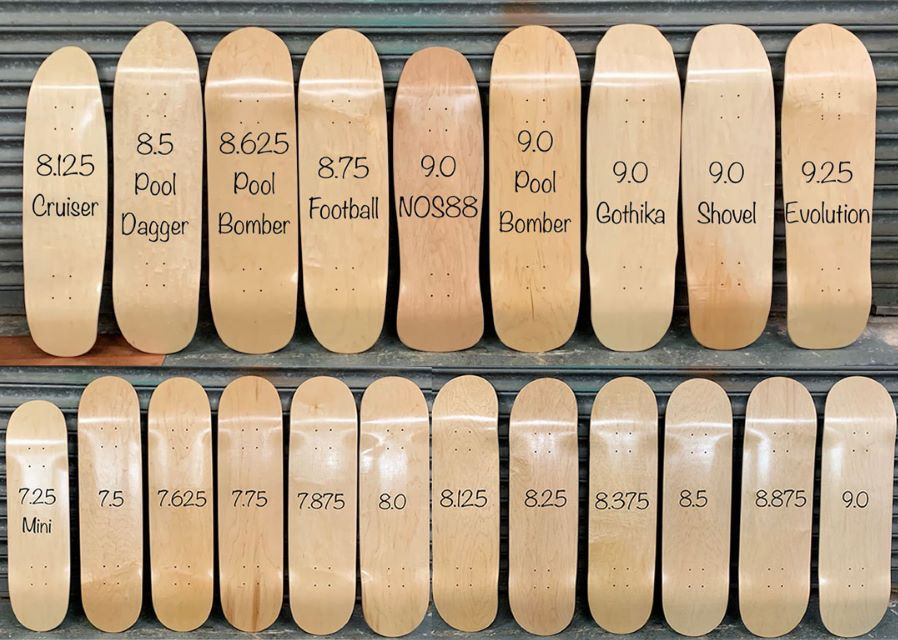
Why Does Skateboard Deck Size Matter?
Deck size affects the relationship between the rider and the board.
Width is particularly important because it changes the available standing platform and can influence stability and maneuverability.
As a general industry reference, many standard skateboard decks fall around 7.5 to 8.5 inches in width, although products outside this range are also available. Wider boards generally provide more standing space and stability, while narrower boards can feel more responsive for technical skating.
For a brand, this means deck size should be connected to the product’s intended use.
A technical street product, children’s skateboard and cruiser-oriented product may all require different dimensions.
How Should You Choose Deck Width?
Width is usually the first dimension to define.
Common product-development ranges include:
7.5–7.75 Inches
These narrower sizes can work well for smaller riders and certain technical-oriented products.
They can also be appropriate for youth-oriented skateboard programs depending on the rider’s age and size.
8.0–8.25 Inches
This is a highly versatile range for general skateboard products.
It can provide a balance between standing platform, responsiveness and stability.
For brands developing a mainstream adult skateboard line, this range can be a useful starting point.
8.25–8.5 Inches
Wider decks provide more standing area and can suit larger riders or products designed around stability and transition-style skating.
8.5 Inches and Wider
Wider decks can be appropriate for specific product categories, including certain pool, vert, cruiser and old-school-inspired designs.
However, wider does not automatically mean better.
The deck should match the intended rider and product category.
How Do Length and Wheelbase Affect Product Design?
Width is important, but it is not the only measurement.
Deck Length
Length is measured from nose to tail.
Longer decks generally provide more overall platform, while shorter boards can be more maneuverable.
For standard street products, length often changes less dramatically than width, but it becomes more important when developing specialized shapes.
Wheelbase
Wheelbase is the distance between the truck mounting positions.
A shorter wheelbase can produce quicker turning characteristics, while a longer wheelbase can provide a more stable feel.
For a product line, wheelbase can therefore be an important tool for differentiating models.
For example, two decks could have a similar width but different wheelbases to create different product characteristics.
Arbor’s deck guide also notes that wheelbase influences maneuverability and stability, making it an important dimension alongside width and length.
For custom specifications, your Skateboard Deck Manufacturer should be able to record these measurements in the production specification.
How Should Brands Build a Product Line?
One common mistake is creating too many sizes too early.
If you are launching a new skateboard brand, a simple product architecture may be more efficient.
For example:
Entry / Youth → Standard → Wide / Specialized
The exact dimensions depend on your target market.
A children’s product line may require several smaller sizes, while a professional-oriented brand may focus on a tighter range of adult deck widths.
Before adding multiple sizes, consider:
- Target market
- Rider age
- Shoe size
- Riding style
- Retail channel
- Product price
- Expected sales volume
- MOQ per SKU
- Inventory cost
Every additional deck size can create another SKU.
That means more artwork, packaging, inventory and production planning.
For distributors and retailers, SKU efficiency can be just as important as technical specifications.
How Should Deck Size Match Trucks and Wheels?
Deck size should never be considered independently from the complete skateboard.
Truck width should generally correspond to deck width so that the finished setup remains balanced. Industry sizing guides commonly match truck axle width to deck width and warn that overly narrow or wide trucks can create handling or clearance issues.
Wheel diameter also affects the final setup.
Larger wheels can change ride height and speed characteristics, while smaller wheels can provide a different response.
If wheel size is increased significantly, the manufacturer may also need to consider riser pads and wheel clearance.
This is why a brand developing complete skateboards should finalize the deck, trucks and wheels as a coordinated system.
You can learn more about complete production on our Complete Skateboard Manufacturer page.
What Should You Send a Manufacturer?
When requesting a quotation, provide a clear size specification.
Ideally, include:
- Deck width
- Deck length
- Wheelbase
- Nose length
- Tail length
- Concave
- Kick angle
- Deck construction
- Truck specification
- Wheel size
- Target quantity
- Target market
If you are unsure which dimensions are appropriate, explain your target customer instead of guessing.
For example:
“We are developing an entry-level skateboard for teenagers in North America.”
This gives the manufacturer useful context.
The factory can then discuss suitable deck sizes, components and production options with you.
If your product requires custom specifications, graphics and packaging, our Custom Skateboards manufacturing service can also support a more complete OEM development process.
FAQ
What is the most common skateboard deck size?
There is no single universal size. Many standard skateboard products fall within approximately 7.5–8.5 inches, with 8.0–8.25 inches often serving as a versatile range for general adult products.
Should a skateboard brand offer multiple deck sizes?
It depends on the target market. Multiple sizes can serve different riders, but each additional size also increases SKU and inventory requirements.
Does deck width affect performance?
Yes. Wider decks generally provide more standing area and stability, while narrower decks can feel more responsive for technical movements.
Does wheelbase matter when choosing deck size?
Yes. Wheelbase affects turning characteristics and stability. It should be considered together with deck width and overall shape.
Should truck size match deck width?
Generally, yes. Truck axle width should be appropriately matched to deck width to maintain balanced handling and avoid clearance problems.
Conclusion
Choosing skateboard deck size for a product line is a product-development decision rather than simply a matter of selecting the most popular size.
Brands should consider width first, then evaluate length, wheelbase, concave, rider profile and intended use.
For a complete skateboard, deck dimensions must also be coordinated with trucks and wheels.
Most importantly, consider the commercial side of your product line.
Every new deck size creates another SKU, another inventory requirement and potentially another packaging specification.
A focused product range with carefully selected sizes can often be easier to manufacture, market and manage than a large collection of nearly identical products.
Yobang Sports works with brands, distributors, sporting-goods buyers and toy companies on custom skateboard deck and complete skateboard manufacturing.
REQUEST A QUOTE
Request a Skateboard Manufacturing Quote
Tell us your target market, rider profile, preferred deck sizes, estimated quantities and product requirements. If you are building a new skateboard product line, we can review your specifications and discuss suitable manufacturing options.