
One of the first questions a skateboard buyer asks a manufacturer is:
“How much does a custom skateboard cost?”
It sounds like a simple question.
In reality, a professional manufacturer cannot give an accurate custom skateboard price from the words “custom skateboard” alone.
The final manufacturing cost depends on many variables:
- Deck material
- Deck size
- Deck construction
- Shape
- Concave
- Graphics
- Printing method
- Trucks
- Wheels
- Bearings
- Grip tape
- Hardware
- Packaging
- Tooling
- Quantity
- Testing
- Quality requirements
This means two skateboards that look similar in a product photo can have very different factory costs.
For brands, distributors and sporting-goods buyers, understanding these cost drivers makes it much easier to evaluate supplier quotations.
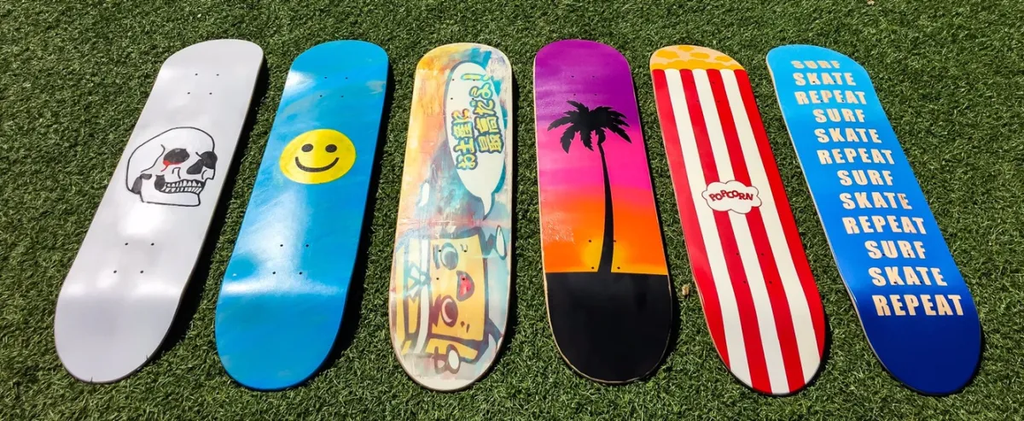
What Determines the Cost of a Custom Skateboard?
The easiest way to understand skateboard manufacturing cost is to divide it into several categories.
1. Deck
The deck is one of the most important cost components.
Price can be affected by:
- Maple grade
- Number of plies
- Veneer thickness
- Deck dimensions
- Shape
- Concave
- Wheelbase
- Construction
- Printing
- Finishing
A standard 7-ply maple deck and a highly customized deck with a new shape and special construction should not be expected to have the same price.
For deck-specific projects, buyers can also review our Skateboard Deck Manufacturer capabilities.
2. Trucks
Truck cost depends on:
- Material
- Width
- Baseplate
- Kingpin
- Bushings
- Finish
- Color
- Custom logo
- Quantity
Aluminum alloy trucks with custom finishes can cost more than standard configurations.
If you are developing a premium skateboard, upgrading the trucks can influence both product cost and product positioning.
However, buyers should evaluate the complete system rather than selecting expensive components simply because they are more expensive.
3. Wheels
Wheel pricing depends on:
- Diameter
- Durometer
- Polyurethane formulation
- Shape
- Contact patch
- Core
- Color
- Graphic
- Quantity
A standard wheel specification may be relatively straightforward.
A custom wheel with special color, logo or formulation can involve additional development and production requirements.
For a product line, wheel selection should be matched with deck size and truck configuration.
4. Bearings
Bearing price can vary significantly.
Factors include:
- Bearing quality
- Material
- Shield/seal configuration
- Lubrication
- ABEC specification
- Branding
- Packaging
Buyers should not assume that the highest ABEC number automatically means the best skateboard bearing.
The bearing should be evaluated based on the complete product requirements.
5. Grip Tape
Grip tape is another component that buyers sometimes overlook.
Cost can depend on:
- Width
- Length
- Grit
- Color
- Printing
- Die-cutting
- Logo
- Backing paper
Standard black grip tape is usually simpler than a fully printed or custom die-cut grip tape.
For a branded skateboard, however, custom grip tape can provide another opportunity for product differentiation.
Graphics and Printing
Graphics are a major part of custom skateboard development.
There are different approaches to printing and decoration.
Depending on the project, manufacturers may evaluate:
- Screen printing
- Heat transfer
- Water transfer
- Other suitable graphic processes
Cost depends on:
- Number of colors
- Artwork complexity
- Print area
- Number of sides
- Setup
- Finishing
- Quantity
A simple one-color logo and a full-color graphic covering the entire deck are not equivalent production jobs.
Therefore, when requesting a quotation, provide the actual artwork whenever possible.
Tooling Cost
Tooling is one of the biggest differences between standard and fully custom skateboards.
If you use an existing factory deck shape, tooling costs may be limited.
If you require a new shape, mold or structural design, the manufacturer may need to create new tooling.
Tooling should normally be treated separately from recurring unit manufacturing cost.
For example:
Tooling: One-time development cost
Production: Recurring unit cost
This distinction is important because a first order may appear more expensive due to tooling and sample development.
Future orders may have a lower effective unit cost.
Quantity Has a Major Impact
Quantity is another major cost driver.
A manufacturing job includes both:
Fixed Costs
Examples:
- Artwork setup
- Tooling
- Sample development
- Production setup
- Fixtures
Variable Costs
Examples:
- Deck material
- Trucks
- Wheels
- Bearings
- Grip tape
- Labor
- Packaging
When the order quantity increases, fixed costs are spread across more units.
This is why a 500-piece order can have a higher unit cost than a 2,000-piece order.
Manufacturing cost guides also identify quantity, tooling, veneer, shape, graphics, finishing, samples, packaging and freight as major cost drivers.
Custom Skateboard Cost Example
Instead of giving one universal price, buyers should think in terms of a cost structure.
For example, imagine a complete skateboard project consisting of:
- Custom maple deck
- Custom graphics
- Aluminum trucks
- PU wheels
- Bearings
- Grip tape
- Hardware
- Custom retail packaging
The factory quotation may contain:
Deck
- Graphics
- Trucks
- Wheels
- Bearings
- Grip Tape
- Hardware
- Packaging
- Labor / Assembly
- Tooling or setup where applicable
= Factory product cost
Then the buyer must consider:
- Freight
- Insurance where applicable
- Import duties/taxes
- Testing
- Warehousing
- Distribution
= Landed cost
This distinction is extremely important.
A factory price is not the same as landed cost.
Why You Should Not Compare Supplier Prices Without Comparing Specifications
Suppose Supplier A quotes:
$X per skateboard
Supplier B quotes:
$Y per skateboard
Supplier A may look cheaper.
But what if Supplier A uses:
- Different maple
- Lower-cost wheels
- Different trucks
- Standard bearings
- Simpler packaging
while Supplier B includes:
- Higher-grade components
- Custom packaging
- Better graphics
- Different deck construction
The prices are not directly comparable.
Always compare the quotation line by line.
How to Request a Comparable Quote
Send every supplier the same specification.
For example:
Deck
- 7-ply maple
- 8.0″
- Standard concave
- Custom graphic
Trucks
- Aluminum alloy
- 5.25″
- Custom color
Wheels
- 54 mm
- 99A
- Custom color
Bearings
- 608 specification
- ABEC requirement
Grip
- Black
- Standard grit
- Custom logo
Packaging
- Custom retail box
- Barcode
- Instruction sheet
Quantity
- 500
- 1,000
- 2,000 pcs
Now suppliers can quote the same product.
This makes price comparison much more meaningful.
Customization Level and Price
There are roughly three levels of skateboard customization.
Basic Customization
- Existing deck
- Custom graphic
- Standard components
- Standard packaging
This is usually the simplest approach.
Mid-Level Customization
- Custom deck dimensions
- Custom colors
- Custom wheel specification
- Custom grip
- Custom packaging
This requires more product development.
Full OEM Development
- New deck shape
- New tooling
- Custom components
- Custom graphics
- Custom packaging
- Special testing
- New product development
This is a significantly more complex project.
The quotation should therefore be based on the actual specification.
How Brands Can Reduce Manufacturing Cost
If your target price is too high, don’t immediately ask the factory to “make it cheaper.”
Instead, identify the cost drivers.
Reduce SKU Count
Fewer SKUs can simplify production.
Standardize Components
Use the same wheels, trucks and bearings across multiple models.
Use Existing Tooling
If an existing deck shape meets your requirements, consider using it.
Simplify Packaging
A simpler package can significantly reduce cost.
Increase Order Quantity
Larger orders can improve unit economics.
Optimize Graphics
Simplifying printing can reduce setup and production costs.
The best cost optimization keeps the product quality and market positioning intact.
Factory Price vs Landed Cost
This distinction deserves special attention.
Suppose a manufacturer gives you a factory price.
That is only one part of the cost.
Your actual cost may include:
- Product cost
- Tooling
- Testing
- Packaging
- Inland transportation
- Export documentation
- Ocean or air freight
- Customs duties
- Import taxes
- Destination handling
- Warehousing
For international B2B buyers, calculate landed cost before deciding the target retail price.
This is especially important when comparing suppliers from different countries.
When Should You Ask for a Quote?
The ideal time is after you have a basic product concept but before you finalize every detail.
A manufacturer can help identify:
- Cost drivers
- MOQ
- Tooling requirements
- Alternative components
- Production feasibility
- Packaging options
If you already have technical drawings and artwork, provide them.
If you only have a reference product, send photos and explain what you want to change.
The manufacturer can then convert the concept into a quotation-ready specification.
How Yobang Approaches Custom Skateboard Projects
For brands developing a custom skateboard, our Custom Skateboards service can support product development around specific deck, graphics, component and packaging requirements.
For OEM projects, see our OEM Skateboard Manufacturer page.
For complete-board production, our Complete Skateboard Manufacturer service covers deck, trucks, wheels, bearings, grip tape, assembly and packaging.
For deck-focused projects, buyers can also review our Skateboard Deck Manufacturer page.
And if you are comparing China manufacturing options, our Skateboard Manufacturer China page explains our China-based production capabilities.
FAQ
How much does it cost to manufacture a custom skateboard?
There is no single price because cost depends on deck construction, components, graphics, packaging, quantity, tooling and other requirements.
Is a custom skateboard more expensive than a standard skateboard?
Usually, customization can increase development and setup costs.
However, the difference depends on what is being customized.
Does MOQ affect unit cost?
Yes.
Larger production quantities can spread fixed setup costs across more units and may improve unit economics.
Is tooling included in the skateboard unit price?
It depends on the supplier.
Ask the factory to separate one-time tooling and development costs from recurring production costs.
Does packaging significantly affect cost?
It can.
Custom retail packaging may add printing, material, tooling and assembly costs.
How can I get an accurate skateboard quote?
Provide deck specifications, components, graphics, packaging, quantity, target market and any reference products.
The more complete the specification, the more accurate the quotation.
Conclusion
The cost of manufacturing a custom skateboard is not determined by one number.
It is the result of many decisions:
Deck + Components + Graphics + Tooling + Packaging + Quantity + Production + Testing + Logistics
For buyers, the best way to control cost is not simply to ask for the cheapest skateboard.
Instead, define the product clearly and understand which specifications are driving the price.
Then compare suppliers based on the same specification.
If you are developing a new skateboard brand or private-label product, request quotations at several quantity levels and separate one-time development costs from recurring manufacturing costs.
REQUEST A QUOTE
Send Yobang Sports your skateboard concept, specifications, artwork and estimated quantity.
Our team can evaluate the project and provide an OEM manufacturing quotation.