
Toy companies looking to expand beyond traditional toys sometimes consider skateboards as an additional product category, especially when developing outdoor play products, action-sports products, lifestyle collections or youth-focused merchandise.
However, sourcing custom skateboards for toy companies is different from sourcing an ordinary consumer product.
A toy company needs to evaluate much more than the appearance and factory price. Product classification, intended age group, materials, mechanical design, testing, labeling, packaging, quality control, production consistency and importer responsibilities can all affect the project.
The first question should therefore not be:
“Which Chinese skateboard factory has the lowest price?”
It should be:
“Which Chinese manufacturer can produce the skateboard specification we need and support the quality, compliance, customization and documentation required for our target market?”
For toy companies, that distinction can make a major difference.
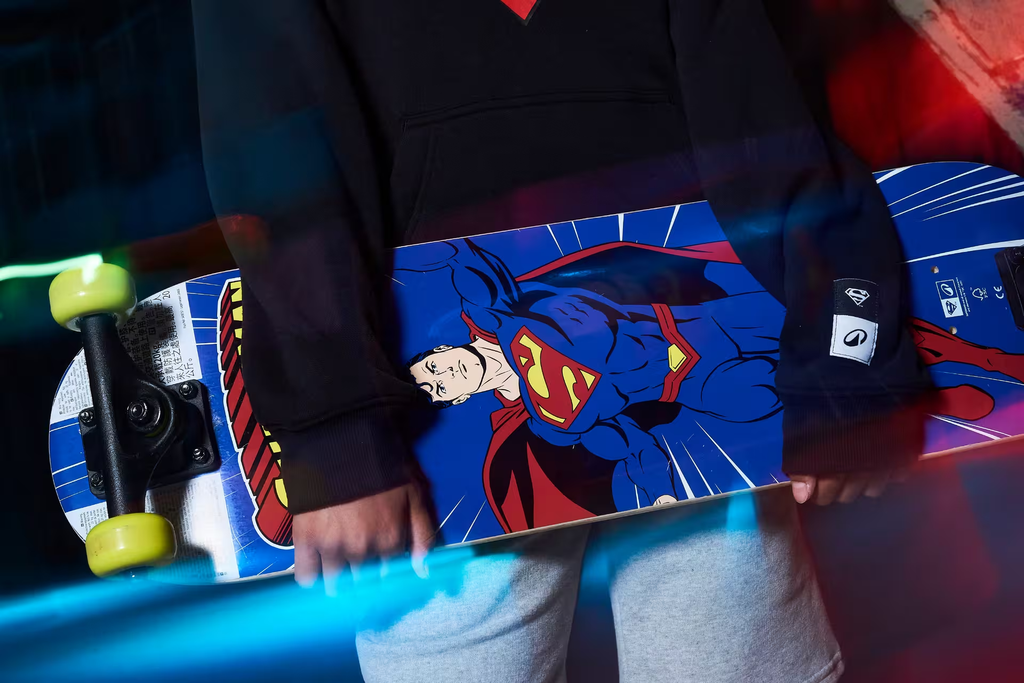
Why Can China Be a Practical Manufacturing Base for Custom Skateboards?
China has a mature manufacturing ecosystem for many skateboard components and related products.
A skateboard project can involve several manufacturing stages:
- Deck material preparation
- Cold pressing
- CNC shaping
- Sanding and finishing
- Graphic printing
- Grip tape preparation
- Truck sourcing
- Wheel sourcing
- Bearing sourcing
- Final assembly
- Packaging
- Quality control
For a buyer, one of the advantages of working with a factory that can coordinate multiple stages is reduced supplier fragmentation.
Instead of separately sourcing decks, components, printing and final assembly, a toy company may be able to manage a larger portion of the product through one manufacturing partner.
For example, Yobang’s manufacturing setup includes wood drying, cold pressing, CNC processing, printing and final assembly, which allows the product to be managed as a finished manufacturing project rather than simply a purchased component.
For buyers comparing suppliers, our skateboard manufacturer in China page provides an overview of factory-level production.
But toy companies should not select a factory based only on manufacturing capability
A factory may produce excellent skateboards but still be a poor fit for a particular toy project.
The buyer must also examine:
- Intended age group
- Product category
- Target market
- Required testing
- Packaging requirements
- Warning labels
- Documentation
- Quality-control procedures
- Traceability
- Production consistency
The appropriate compliance path depends on how the product is designed, marketed and classified.
This is particularly important for products intended for children.
How Should a Toy Company Define the Skateboard Product Before Sourcing?
The manufacturing process becomes much easier when the product definition is clear.
Toy companies should prepare a product specification covering at least five areas.
1. Intended user and age group
Start with:
Who is the product actually designed for?
For example:
- Young children
- Older children
- Teens
- Family use
- Beginners
- Outdoor toy market
- Sporting-goods market
Age grading is not simply a marketing decision. It can influence product safety evaluation, testing and labeling requirements.
This is why the factory should know the intended audience before finalizing the specification.
2. Product construction
A toy company may choose between:
Maple deck construction
or
PP deck construction
depending on the product concept.
PP can be useful for certain entry-level or youth-oriented designs because it allows different forms of shaping and coloration.
Maple offers a more traditional skateboard construction and may be selected when the product needs a conventional skateboard appearance or structure.
Neither material is automatically the correct answer for every project.
The correct selection depends on:
- Intended user
- Product positioning
- Design
- Cost target
- Performance expectations
- Manufacturing requirements
3. Complete skateboard or deck-only
Toy companies should decide whether they need:
Complete assembled skateboards
or
Decks/components for later assembly.
For most toy companies entering the category for the first time, complete assembled products can simplify procurement, packaging and inventory management.
However, the best structure depends on the company’s supply chain.
4. Product appearance
Children’s products are often highly visual.
Toy companies may require:
- Bright colorways
- Characters
- Patterns
- Logos
- Thematic artwork
- Custom grip tape
- Custom wheels
- Printed packaging
Artwork should be considered early because it affects both product development and packaging.
5. Packaging
A toy product may require a packaging system designed for retail.
Possible requirements include:
- Full-color box
- Window packaging
- Product photography
- Age indication
- Warnings
- Instruction sheet
- Barcode
- Country-of-origin marking
- Distributor/importer information
- Retail labels
Packaging should be developed alongside the product rather than after production begins.
What Compliance Issues Should Toy Companies Consider?
This is one of the most important areas of the sourcing process.
A skateboard intended for a child is not automatically governed by exactly the same requirements as every other skateboard. Product classification and intended use matter.
For the United States, the CPSC states that toys intended primarily for children 12 years and under are subject to applicable children’s product safety requirements, including 16 CFR Part 1250, which incorporates ASTM F963. CPSC also states that third-party testing and a Children’s Product Certificate are required for covered children’s toys.
At the same time, CPSC’s own guidance distinguishes sporting goods from toys in several contexts. That means a buyer should not simply put “ASTM F963” on a product specification and assume that this alone defines the entire compliance strategy. The intended use, marketing and applicable regulations need to be evaluated for the specific product.
The manufacturer should be involved early
A toy company should communicate:
- Target market
- Intended age range
- Product classification assumptions
- Materials
- Surface coatings
- Components
- Packaging
- Intended sales channel
Then the buyer and appropriate testing/compliance professionals can determine which requirements apply.
The responsibility for market compliance should not be treated as something the factory “automatically handles.”
For overseas products entering the United States, the importer also has important responsibilities. CPSC states that for children’s products manufactured overseas, the importer is responsible for issuing the CPC.
The EU market requires a separate assessment
European toy regulation is also evolving.
The EU adopted Regulation (EU) 2025/2509 on the safety of toys, which repeals the previous Toy Safety Directive with the new regulation applying from 1 August 2030; certain provisions already apply from earlier dates. The regulation specifically includes skateboards among products for which toy-related warnings may apply when they are offered for sale as toys.
Therefore, toy companies sourcing today should avoid treating “CE + EN71” as a generic checkbox.
Instead, the manufacturer and compliance team should determine:
What exactly is the product?
Who is the intended user?
How is it marketed?
Which legal framework applies in the destination market?
This is much more robust than copying a list of certificates from another supplier.
Testing should match the actual product
A strong sourcing process should ask:
- Which tests are applicable?
- Which laboratory will perform them?
- What samples are required?
- Are materials tested separately?
- Does packaging require specific information?
- Are warnings required?
- Who maintains the technical/test documentation?
- Who issues the final compliance documentation?
CPSC specifically advises businesses to identify the applicable sections of the toy standard and work with a CPSC-accepted third-party laboratory where required.
For a toy company, this is why selecting the factory before finalizing the product specification can sometimes save time. Compliance requirements can influence materials, graphics, components and packaging.
How Should Toy Companies Evaluate a Chinese Skateboard Factory?
A professional sourcing process should look beyond a factory website.
Factory capability
Ask for information about:
- Factory location
- Manufacturing area
- Production lines
- Deck production
- CNC processing
- Printing
- Assembly
- Packaging
- Quality control
If the supplier only trades finished products from multiple third parties, the buyer should understand exactly which parts of the production are controlled by the supplier.
Experience with children-focused products
A factory that mainly manufactures adult skateboards may not automatically have the same experience with:
- Children’s packaging
- Age grading
- Toy-market specifications
- Testing coordination
- Retail requirements
- Child-focused product documentation
The buyer should ask for examples of similar projects.
Sample process
A proper sample should allow the toy company to evaluate:
- Product dimensions
- Weight
- Graphics
- Construction
- Grip tape
- Component assembly
- Packaging
The final production specification should be approved before mass production.
Documentation
Ask what documentation the factory can provide.
Depending on the project, this may include:
- Material specifications
- Product specifications
- Test reports
- Factory QC records
- Packaging specifications
- Inspection records
- Production photos
- Batch information
A factory should not simply say:
“We have CE.”
Ask:
“CE for what product, to which applicable requirements, based on which documentation?”
That is a much more professional sourcing question.
Quality control
For children’s products, quality should be evaluated at several levels.
Incoming material inspection
Are the materials consistent with the approved specification?
In-process inspection
Are dimensions, printing and assembly controlled during production?
Final inspection
Does the finished product match the approved sample?
Packaging inspection
Are labels, instructions, warnings and cartons correct?
The buyer should have a clear inspection checklist.
How Does a China Sourcing Project Usually Work?
A structured process can reduce surprises.
Step 1 — Product concept
Define user, age group, product type, market and price position.
Step 2 — Technical specification
Define deck, components, graphics, packaging and dimensions.
Step 3 — Factory selection
Evaluate manufacturing capability, experience and communication.
Step 4 — Compliance assessment
Identify the regulatory and testing requirements for the target market and product classification.
Step 5 — Sampling
Create and review physical samples.
Step 6 — Testing
Where required, submit final or appropriate samples to the relevant laboratory.
Step 7 — Production approval
Lock specifications, artwork and packaging.
Step 8 — Mass production
Manufacture according to the approved specification.
Step 9 — Quality inspection
Inspect product and packaging before shipment.
Step 10 — Export preparation
Finalize documentation, cartons, shipping marks and logistics.
This sequence is much safer than ordering first and asking about testing afterward.
Toy companies that need a more detailed supplier comparison can also review our kids skateboard manufacturer page.
FAQ: Sourcing Custom Skateboards from China
Can toy companies order custom skateboards directly from China?
Yes. Toy companies can source custom skateboards from Chinese manufacturers, including complete boards, custom decks, youth-oriented products and private-label programs.
Can a toy company customize the skateboard artwork?
Yes. Custom deck graphics, grip tape graphics, wheel colors, packaging and branding can be included depending on the order quantity and production method.
Are children’s skateboards subject to toy safety requirements?
It depends on how the specific product is classified, marketed and intended to be used. In the U.S., covered children’s toys intended primarily for children 12 and under are subject to applicable CPSC children’s product safety requirements, including the applicable ASTM F963 provisions.
Does every skateboard need ASTM F963?
No. ASTM F963 applies within the U.S. toy-safety framework; it should not be treated as a universal requirement for every skateboard. Product classification and intended use matter.
Who is responsible for a Children’s Product Certificate in the U.S.?
For products manufactured overseas, the U.S. importer is responsible for issuing the CPC based on the applicable supporting documentation and testing.
Can toy companies order a small quantity?
Potentially. MOQ depends on product specifications, customization, packaging, number of SKUs and production setup.
How should a company choose a Chinese skateboard factory?
Evaluate manufacturing capability, similar-project experience, quality-control procedures, sample development, testing/documentation support, packaging capability and communication—not only unit price.
How do I request a quotation?
Provide your target quantity, age group, target market, product type, artwork, deck specification, components, packaging and required delivery timeline.
Conclusion
Sourcing custom skateboards for toy companies from China can be practical when the project is treated as a complete product-development and compliance program rather than a simple commodity purchase.
The strongest sourcing process begins with product classification and intended use.
After that, the company can define the skateboard construction, customization, packaging, testing requirements, production quantity and delivery schedule.
For children’s products, compliance should be considered before mass production. The applicable requirements depend on the specific product and market, and official regulatory guidance should be used rather than relying on a supplier’s generic certificate list.
The manufacturer also needs to be able to translate the product concept into a consistent production specification.
For a toy company, the objective is not simply to find a Chinese factory that can make a skateboard.
It is to find a manufacturing partner that can produce the right product, at the right quantity, with the right documentation and quality controls for the intended market.
REQUEST A QUOTE
Developing a custom skateboard product for a toy brand?
Send us your target age group, destination market, quantity, deck requirements, artwork and packaging specifications.
Yobang Sports can review the project and discuss suitable production and customization options.