
When sourcing skateboards for children, retailers, toy companies, sporting-goods brands and distributors often ask the same question:
What certifications and standards should a kids skateboard meet?
Three terms frequently appear in supplier discussions:
- ASTM F963
- EN 13613
- FSC certification
Although they are often mentioned together, they are not the same type of requirement.
ASTM F963 is a U.S. toy safety standard incorporated into the federal regulatory framework for children’s toys. EN 13613 is a European standard addressing safety requirements and test methods for non-motorized skateboards. FSC certification, meanwhile, concerns responsible sourcing and chain of custody for forest-based materials.
For a skateboard buyer, understanding the difference is extremely important.
A factory may have experience producing FSC-certified wood products, but that does not automatically mean every skateboard is compliant with every applicable children’s product safety requirement.
Likewise, a skateboard passing a safety test does not automatically make its wooden components FSC-certified.
The correct approach is to look at product classification, target age, destination market, materials, intended use and the complete skateboard configuration.
For brands and importers, these requirements should be discussed with the manufacturer before samples and mass production are finalized.
What Is ASTM F963?
ASTM F963 is the U.S. toy safety standard.
The U.S. Consumer Product Safety Commission explains that ASTM F963 became a mandatory children’s toy safety standard under the Consumer Product Safety Improvement Act and is incorporated into 16 CFR Part 1250. For toys manufactured after April 20, 2024, the currently applicable version is ASTM F963-23.
This is important for companies selling children’s products in the United States.
However, buyers should not interpret ASTM F963 as simply a “certificate that every skateboard needs.”
The applicable requirements depend on how the product is classified and marketed.
A skateboard designed and marketed as a children’s toy can raise different regulatory considerations from a skateboard marketed as sporting equipment for older users.
This is why the product’s:
- Intended age
- Intended use
- Product design
- Marketing language
- Target consumer
- Components
- Materials
should all be considered.
What Does ASTM F963 Cover?
ASTM F963 is a broad toy safety standard.
Depending on the product, relevant areas can include:
- Mechanical and physical properties
- Small parts
- Accessible edges and points
- Material-related hazards
- Flammability
- Toxicology
- Stability
- Wheels, tires and axles
- Other potential hazards associated with toys
CPSC explains that manufacturers and importers of children’s products subject to applicable CPSC requirements may also need to issue a Children’s Product Certificate (CPC) based on the applicable testing and regulations.
Therefore, if you are developing a kids skateboard for the U.S. market, the right question for your factory is not simply:
“Do you have ASTM F963?”
A better question is:
“Can you support testing and documentation for the exact skateboard specification we intend to sell in the U.S. market?”
That distinction can prevent problems later.
What Is EN 13613?
EN 13613 is a European standard concerning safety requirements and test methods for non-motorized skateboards.
For buyers, it is important to understand that EN 13613 should not simply be treated as a universal European certification for every children’s skateboard.
The applicability of the standard depends on the product and intended rider.
For example, European standards may distinguish products according to their intended use and rider characteristics.
This is particularly important for children’s products.
A product designed for a very young child should not automatically be treated as a miniature version of an adult skateboard.
The manufacturer and testing laboratory should evaluate the actual product specification and intended market before determining the applicable testing route.
Why Does EN 13613 Matter to Buyers?
If your company is importing skateboards into Europe, you need to understand the applicable European requirements before production.
Your supplier should be able to discuss:
- Product classification
- Intended rider
- Product dimensions
- Maximum rider weight
- Construction
- Wheel and truck configuration
- Mechanical safety
- Applicable testing
This becomes especially important for products sold through major retailers.
A buyer may need technical files, test reports, declarations or other documentation depending on the product and applicable legislation.
Therefore, compliance should be treated as part of product development rather than something checked after production.
What Is FSC Certification?
FSC stands for the Forest Stewardship Council.
Unlike ASTM F963 and EN 13613, FSC certification is not primarily a skateboard safety standard.
It relates to responsible sourcing and traceability of forest-based materials.
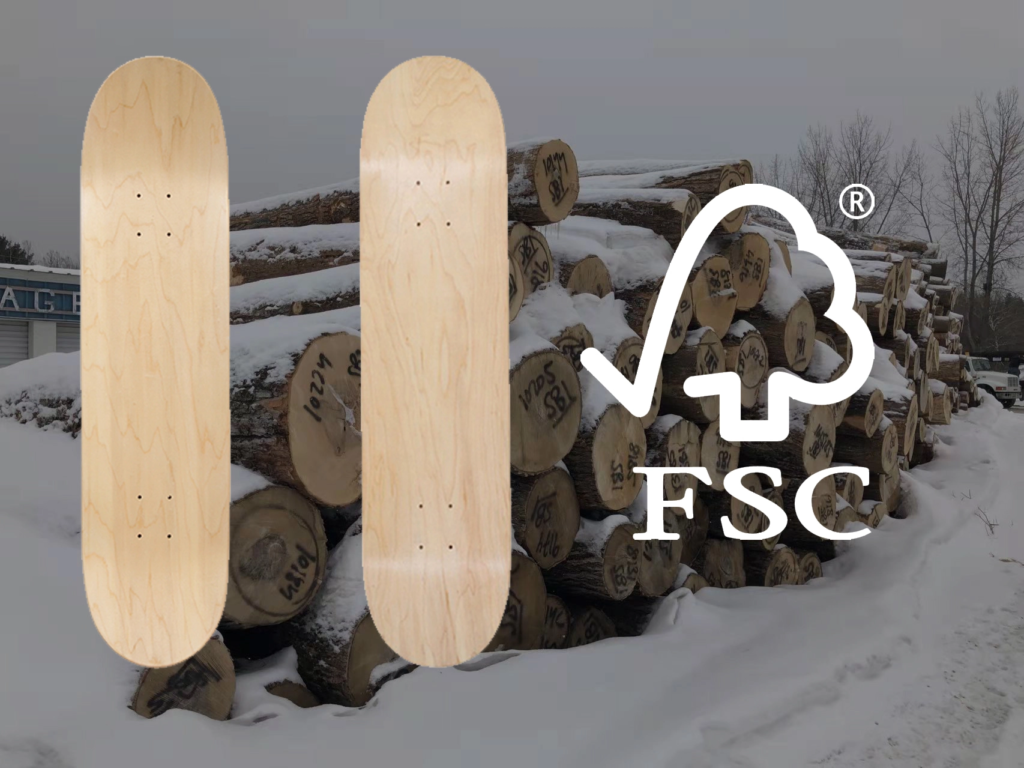
FSC Chain of Custody certification allows certified organizations to track FSC-certified material through the supply chain and make appropriate FSC claims. FSC explains that organizations involved in transforming, processing or distributing forest-based products generally need the appropriate certification to sell products with FSC claims or FSC labels.
For skateboard manufacturers, FSC can become relevant because traditional skateboard decks use wood.
However, there is an important distinction:
Using wood does not automatically make a skateboard FSC-certified.
The supply chain and chain of custody must support the claim.
This means buyers should ask:
- Is the wood FSC-certified?
- Is the supplier FSC-certified?
- Does the manufacturer’s FSC certificate cover the relevant product scope?
- Can the manufacturer provide the necessary FSC claim?
- Can FSC documentation be maintained through production and sales?
FSC’s Chain of Custody system includes requirements around sourcing, identification, separation, traceability and record keeping.
ASTM F963 vs EN 13613 vs FSC: What Is the Difference?
| Requirement | Main Purpose | Typical Relevance |
|---|---|---|
| ASTM F963 | Children’s toy safety | U.S. children’s products where applicable |
| EN 13613 | Skateboard safety requirements/test methods | European skateboard products where applicable |
| FSC | Responsible forest-material sourcing and chain of custody | Wooden products with FSC claims |
| CPC | U.S. certification document | Applicable children’s products in the U.S. |
| Factory QC | Production consistency | Every commercial product |
The most important point is that these are not interchangeable certifications.
An FSC-certified skateboard is not automatically ASTM F963 compliant.
An ASTM-tested product is not automatically FSC-certified.
An EN-tested skateboard is not automatically compliant with every other European requirement.
Each requirement answers a different question.
What Should Skateboard Buyers Ask a Manufacturer?
Before placing a purchase order, buyers should create a compliance checklist.
1. What Is the Target Market?
Tell the manufacturer whether the product will be sold in:
- United States
- Canada
- United Kingdom
- European Union
- Australia
- Other markets
Do not simply say “worldwide.”
Different markets can have different requirements.
2. What Is the Target Age?
This is particularly important for children’s skateboards.
Provide:
- Minimum age
- Maximum age
- Target rider weight
- Intended use
The factory needs this information before recommending a specification.
3. Is the Product a Toy or Sporting Product?
Classification can affect the applicable compliance route.
Marketing language, packaging and intended use can all matter.
4. What Materials Are Used?
For a maple skateboard, discuss:
- Maple veneer
- Adhesives
- Paint
- Ink
- Coatings
- Grip tape
- Wheels
- Trucks
- Bearings
- Packaging
If FSC is required, discuss the wood supply chain separately.
5. Can the Manufacturer Support Testing?
A good OEM manufacturer should be able to coordinate samples and provide information needed for laboratory testing.
However, buyers should remember that a factory’s statement is not the same thing as an independent test report.
Testing should be conducted through an appropriate laboratory when required.
FSC and Sustainable Skateboard Product Development
FSC can also be part of a brand’s sustainability strategy.
Retailers increasingly request responsible sourcing information from suppliers.
For a skateboard brand, FSC certification can become part of:
- Product specifications
- Retailer onboarding
- Sustainability programs
- Packaging communication
- Product labeling
- B2B documentation
FSC itself states that Chain of Custody certification can support market access and allow certified organizations to make FSC claims in sales documents.
For brands targeting environmentally conscious consumers, this can be a meaningful product differentiator.
However, avoid making unsupported environmental claims.
If you want to advertise a skateboard as FSC-certified, the appropriate FSC documentation and claim requirements should be confirmed.
Why Compliance Should Be Considered Before the RFQ
One of the most expensive mistakes in product development is waiting until the end to think about compliance.
Imagine a toy company develops a skateboard with:
- Custom deck
- Custom graphics
- Custom packaging
- Character artwork
- Custom wheels
The company then completes mass production.
Only afterward does the buyer discover that the product specification needs to change for the target market.
The result could be:
- New samples
- New testing
- Packaging changes
- Artwork changes
- Production delays
- Additional tooling costs
- Inventory problems
This is why compliance should be included in the initial RFQ.
When working with a Kids Skateboard Manufacturer, provide the intended market and age group at the beginning of the project.
If you are sourcing complete boards, our Complete Skateboard Manufacturer capabilities cover the complete product rather than the deck alone.
For overseas buyers looking for a China-based production partner, our Skateboard Manufacturer China page provides additional information about factory manufacturing and OEM production.
You can also review our Skateboard Manufacturing Process to understand how material selection, pressing, shaping, printing, assembly and quality control fit into production.
How to Build a Compliance Checklist
Before approving a sample, buyers should prepare a simple checklist.
Product
- Product name
- Product type
- Target age
- Rider weight
- Intended use
- Target market
Materials
- Deck material
- Adhesives
- Paint
- Ink
- Grip tape
- Wheels
- Trucks
- Bearings
Testing
- Applicable U.S. requirements
- Applicable European requirements
- Mechanical testing
- Material testing
- Chemical testing where applicable
- Third-party laboratory requirements
FSC
- FSC material requirement
- Supplier certification
- Chain of Custody
- FSC claim
- Label requirements
Documentation
- Test reports
- Certificates
- Product specifications
- Packaging information
- Batch records
- Quality-control records
This approach is much more reliable than asking the supplier for “all certificates.”
FAQ
Does every kids skateboard need ASTM F963?
Not every skateboard automatically falls under the same U.S. requirements. Applicability depends on product classification, intended age and use. Buyers should determine the applicable requirements for the exact product.
Is ASTM F963 the same as EN 13613?
No.
ASTM F963 is a U.S. toy safety standard, while EN 13613 addresses safety requirements and test methods for non-motorized skateboards in the European standards framework.
Is FSC a safety certification?
No.
FSC concerns responsible forest-material sourcing and chain of custody. It should not be treated as a product safety certification.
Can a skateboard be both FSC and ASTM compliant?
Potentially, yes.
These address different aspects of the product. A wooden skateboard can use FSC-certified materials while the finished product is separately tested against applicable safety requirements.
Should buyers ask for FSC before production?
Yes, if FSC is important to the product.
It is better to confirm the supply chain and documentation before production rather than trying to establish an FSC claim afterward.
Conclusion
ASTM F963, EN 13613 and FSC certification answer three different questions.
ASTM F963 focuses on applicable toy safety requirements in the United States.
EN 13613 addresses safety requirements and test methods for relevant non-motorized skateboard products.
FSC addresses responsible sourcing and chain of custody for forest-based materials.
For skateboard buyers, the key is not collecting as many certificates as possible.
The key is identifying which requirements apply to your exact product, target market and target consumer.
If you are developing a kids skateboard for the U.S., Europe or another international market, discuss the target market and compliance requirements with your manufacturer before approving the final specification.
REQUEST A QUOTE
Planning a children’s skateboard project?
Send Yobang Sports your target market, age group, quantity and product concept.